Watering houseplants seems simple: pour water into the pot, let it drain, and repeat when the soil dries out. Yet countless indoor plants struggle not because they receive too little water—but because they cannot absorb it efficiently. Leaves wilt, roots rot, soil dries unevenly, and growth stalls, even when owners follow careful watering schedules.
The surprising truth is that the solution often isn’t more water or better fertilizer. Instead, it’s a small change in how water moves through the soil—a shift that dramatically improves root hydration, oxygen balance, and overall plant health.
That change is improving soil structure and wetting behavior, specifically by making the growing medium more receptive to water rather than water-repellent.
Why Indoor Plants Struggle to Absorb Water
In nature, plants grow in living soils rich in organic matter, microbes, air pockets, and continuous moisture movement. Indoor plants, by contrast, live in artificial environments:
- Confined pots
- Sterile or compacted potting mixes
- Irregular watering cycles
- Dry indoor air
Over time, many potting mixes develop a hidden problem: hydrophobic soil.
What Is Hydrophobic Soil?
Hydrophobic soil repels water instead of absorbing it. When you water such a pot, the water may:
- Run straight down the sides of the pot
- Pool on the surface without soaking in
- Exit the drainage holes almost immediately
The result is dry root zones even after watering. The plant experiences drought stress while the grower assumes the problem is solved.
The Small Change: Restoring Even Moisture Distribution
The most effective small change you can make is improving how water penetrates and spreads through the potting mix.

This can be achieved by adding or reintroducing fine organic material that increases soil wettability and capillary action—the ability of soil to pull water sideways and upward toward roots.
In practical terms, this means:
- Using a better-balanced potting mix
- Incorporating moisture-retentive but breathable materials
- Changing how water is applied, not just how often
Why Water Movement Matters More Than Quantity
Roots don’t “drink” water like a straw. Instead, they absorb moisture from thin films of water clinging to soil particles. For this to happen, water must:
- Spread evenly through the soil
- Move slowly enough to be retained
- Leave air spaces intact for oxygen
If water drains too fast or bypasses dry pockets, roots remain dehydrated no matter how often you water.
Efficient absorption depends on soil physics, not watering volume.
The Role of Organic Matter in Water Absorption
One of the most effective small changes is increasing stable organic matter in the potting mix.
Materials such as:
- Coco coir
- Fine compost
- Worm castings
act like microscopic sponges. They hold water at the right tension for roots to access while still allowing excess moisture to drain.

Unlike peat alone, these materials rehydrate easily after drying out.
Why Coco Coir Is Especially Effective
Coco coir has become popular for a reason:
- It absorbs water quickly
- It rehydrates even after complete drying
- It resists compaction
- It maintains air spaces
Replacing a portion of peat-based mix with coco coir can dramatically improve water uptake without increasing the risk of root rot.
The Hidden Enemy: Compaction
Another major barrier to water absorption is soil compaction.
Over time, gravity, repeated watering, and root growth compress potting mix. Compacted soil:
- Reduces pore space
- Blocks oxygen flow
- Forces water to channel around roots
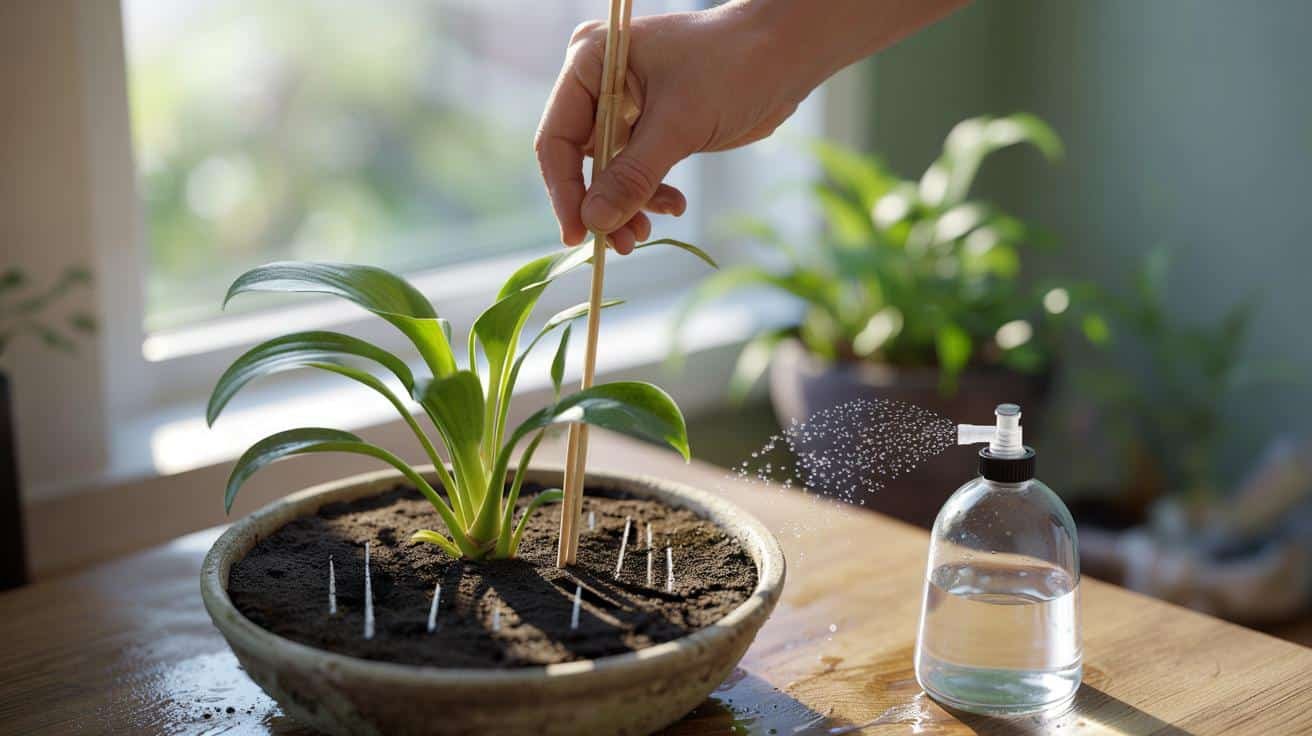
A simple change—loosening the top layer of soil periodically—can restore porosity and improve water infiltration.
This does not mean disturbing roots aggressively. Gently breaking the surface crust with a chopstick or fork is often enough.
Why Bottom Watering Helps (But Isn’t the Whole Answer)
Bottom watering is often recommended for struggling houseplants, and for good reason.

By placing the pot in a tray of water and allowing moisture to rise through drainage holes, you:
- Rehydrate dry soil evenly
- Avoid surface runoff
- Encourage deeper root growth
This method works because it restores capillary action, pulling water upward through the entire soil column.
However, bottom watering alone is not enough if the soil itself has become resistant to moisture. Improving soil structure ensures that bottom watering actually benefits the roots.
The Oxygen–Water Balance
Efficient water absorption is inseparable from oxygen availability.
Roots require oxygen to function. When soil stays waterlogged, roots suffocate and lose the ability to absorb water—ironically causing wilting despite wet soil.
The small change here is counterintuitive: better drainage often improves hydration.
By adding materials like perlite, pumice, or coarse sand in moderation, you:
- Prevent water from stagnating
- Maintain air pockets
- Keep roots metabolically active
Healthy roots absorb water faster and more effectively.

How Water Quality Affects Absorption
Water itself can influence soil behavior.
Hard water high in dissolved salts can:
- Alter soil structure
- Reduce water penetration
- Create surface crusts
Allowing tap water to sit for 12–24 hours, or occasionally flushing soil with distilled or rainwater, helps reset soil chemistry and improve absorption.
This is a subtle but meaningful adjustment many indoor gardeners overlook.
Signs Your Plants Are Absorbing Water Efficiently
Once soil wettability improves, plants show rapid changes:
- Leaves remain firm longer between waterings
- New growth appears more consistently
- Root systems expand evenly
- Pots feel heavier for longer after watering
Importantly, watering frequency often decreases—not because plants need less water, but because they finally have access to it.
Why Overwatering Is Often Misdiagnosed
Many cases of “overwatering” are actually poor absorption problems.
Water pools at the bottom of the pot while upper roots remain dry. Growers respond by watering less, which worsens dehydration in the root zone.

By improving how water spreads, plants receive what they need without excess.
A Small Change With Large Effects
Improving water absorption does not require expensive tools, fertilizers, or constant attention. It requires understanding how water behaves in confined soil systems.
By:
- Enhancing soil organic matter
- Preventing compaction
- Encouraging even moisture movement
- Supporting oxygen flow
you create conditions where plants naturally regulate their hydration.
This single adjustment often resolves issues that seem unrelated—yellowing leaves, slow growth, root rot, and chronic wilting.
Conclusion: Let the Soil Do the Work
The small change that makes indoor plants absorb water more efficiently isn’t about watering more often or following rigid schedules. It’s about restoring the soil’s ability to welcome water instead of rejecting it.