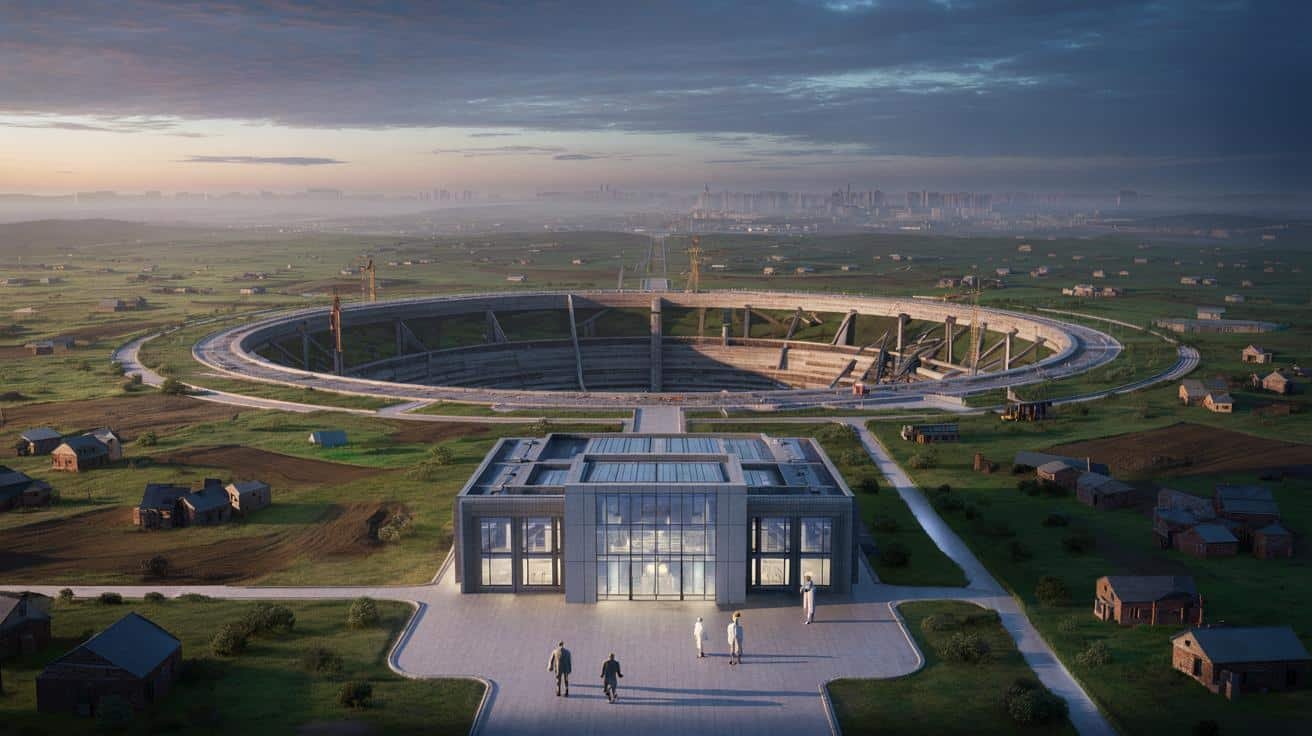
For more than a decade, China has signaled its intention to become a global leader in fundamental physics. Central to that ambition was a bold scientific vision: to build the world’s largest particle accelerator, a machine that would surpass Europe’s Large Hadron Collider (LHC) in both size and power. The proposed project—known as the Circular Electron Positron Collider (CEPC), with a future upgrade to a Super Proton-Proton Collider (SPPC)—promised to place China at the forefront of particle physics for generations.
Yet in a striking development, China has effectively halted or indefinitely delayed this megaproject. The reason is simple, and unusually candid for a country known for large-scale infrastructure spending: the cost is too high, even for the world’s second-largest economy.
The pause reveals much more than budgetary caution. It highlights the escalating financial demands of “big science,” shifting national priorities, and a global reckoning over how far humanity is willing—or able—to go in the pursuit of fundamental knowledge.
The Dream of a Chinese Super Collider
Particle accelerators are among the most complex machines ever built. By smashing subatomic particles together at near-light speeds, they allow physicists to probe the fundamental structure of matter and the forces that govern the universe.
Europe’s Large Hadron Collider, operated by CERN near Geneva, is currently the most powerful accelerator in the world. It famously confirmed the existence of the Higgs boson in 2012, a discovery that reshaped modern physics.
China’s proposal aimed to go even further.
The CEPC was envisioned as a 100-kilometer circular collider, nearly four times the circumference of the LHC. It would first operate as a “Higgs factory,” producing enormous numbers of Higgs particles with unprecedented precision. Later, it could be upgraded into the SPPC, capable of proton collisions at energies far beyond anything currently achievable.

If completed, the project would have positioned China as the uncontested center of high-energy physics.
Why Particle Accelerators Are So Expensive
The decision to halt the project underscores a sobering reality: modern particle physics has reached a point where scientific ambition collides with financial limits.
Building a next-generation collider requires:
- Massive underground tunneling
- Ultra-high-precision superconducting magnets
- Cryogenic systems operating near absolute zero
- Decades-long commitments to operation and maintenance
- Thousands of specialized scientists and engineers
Early estimates for the CEPC alone ranged from $5 to $10 billion, with the full CEPC–SPPC complex potentially exceeding $20 billion or more over its lifetime.
These figures rival the cost of major national infrastructure programs—and unlike high-speed rail or power grids, particle accelerators do not generate direct economic returns.
Competing Priorities in a Changing China
China is no stranger to megaprojects. From the Three Gorges Dam to the world’s largest high-speed rail network, it has repeatedly demonstrated its capacity to fund and execute enormous undertakings.
So why stop now?

The answer lies in shifting national priorities.
China is currently grappling with:
- Slower economic growth
- A real estate downturn
- Demographic decline and an aging population
- Rising healthcare and social welfare costs
- Strategic competition in semiconductors, AI, and defense
In this context, funding a multibillion-dollar physics experiment with uncertain outcomes has become harder to justify politically and economically.
Basic science remains important—but it must now compete with applied technologies seen as more immediately critical to national strength.
Big Science in an Era of Budget Reality
China’s decision reflects a broader global trend. Around the world, governments are becoming more cautious about funding single, ultra-expensive scientific instruments.
In Europe, debates continue over whether to build a Future Circular Collider (FCC)—a project similar in scale and cost to China’s CEPC. In the United States, proposals for next-generation colliders have repeatedly stalled due to funding concerns.
The challenge is structural: each new collider must be significantly larger and more powerful than the last to unlock new physics, driving costs exponentially higher.

As one physicist famously remarked, “We are approaching the limits of what civilization is willing to pay for higher energies.”
Scientific Promise Versus Uncertain Payoff
Proponents of the Chinese collider argued that the potential rewards justified the investment.
The CEPC could have:
- Measured the Higgs boson with extreme precision
- Revealed new particles beyond the Standard Model
- Provided clues about dark matter and extra dimensions
- Advanced accelerator, magnet, and cryogenic technologies
But unlike the Higgs discovery—which had strong theoretical motivation—future breakthroughs are less certain. There is no guarantee that higher energies will reveal new physics quickly, or at all.
This uncertainty makes funding decisions increasingly difficult in an era where governments demand measurable returns.
International Collaboration—or Competition?
One proposed solution was international collaboration. CERN itself is a multinational organization funded by dozens of countries, spreading costs and benefits.
China explored the idea of opening the CEPC to global participation, inviting foreign scientists and funding partners. However, geopolitical tensions, concerns over data sharing, and strategic competition limited enthusiasm.

In contrast to CERN’s Cold War-era origins—where collaboration served as scientific diplomacy—the current global climate is far less conducive to shared megaprojects of this scale.
The result: China was largely expected to shoulder the financial burden alone.
What Halting the Project Really Means
It is important to note that “halting” does not necessarily mean permanent cancellation. In China, large projects are often paused, re-evaluated, and revived under different conditions.
The CEPC still exists in planning documents. Research groups continue working on accelerator technology, detector design, and theoretical groundwork. But the timeline has effectively slipped from the 2030s into an undefined future.
For now, the political will to proceed simply is not there.
Implications for Global Particle Physics
China’s pause has significant global consequences.
Without a next-generation collider on the horizon, particle physics may enter a period of consolidation rather than expansion. Scientists will rely more heavily on:

- Precision experiments at existing facilities
- Smaller, specialized accelerators
- Astrophysical and cosmological observations
- Non-accelerator searches for dark matter
The era of ever-larger machines may be slowing—not because curiosity has faded, but because the financial and political costs have become too steep.
A Turning Point for Scientific Ambition
The decision also challenges assumptions about China’s willingness to fund prestige science projects at any cost. It suggests a more pragmatic approach—one that weighs national needs against symbolic leadership in fundamental research.
In doing so, China joins a growing number of nations confronting the same question: how much is humanity willing to spend to understand the deepest laws of nature?
Conclusion: When Even Giants Hesitate
The halting of China’s bid to build the world’s largest particle accelerator is not a failure of science—it is a reflection of reality.
As particle physics pushes against technological and financial limits, even the most ambitious nations must pause and reconsider. The universe still holds countless mysteries, but unlocking them may require new approaches, new technologies, or new forms of collaboration—rather than simply building bigger machines.