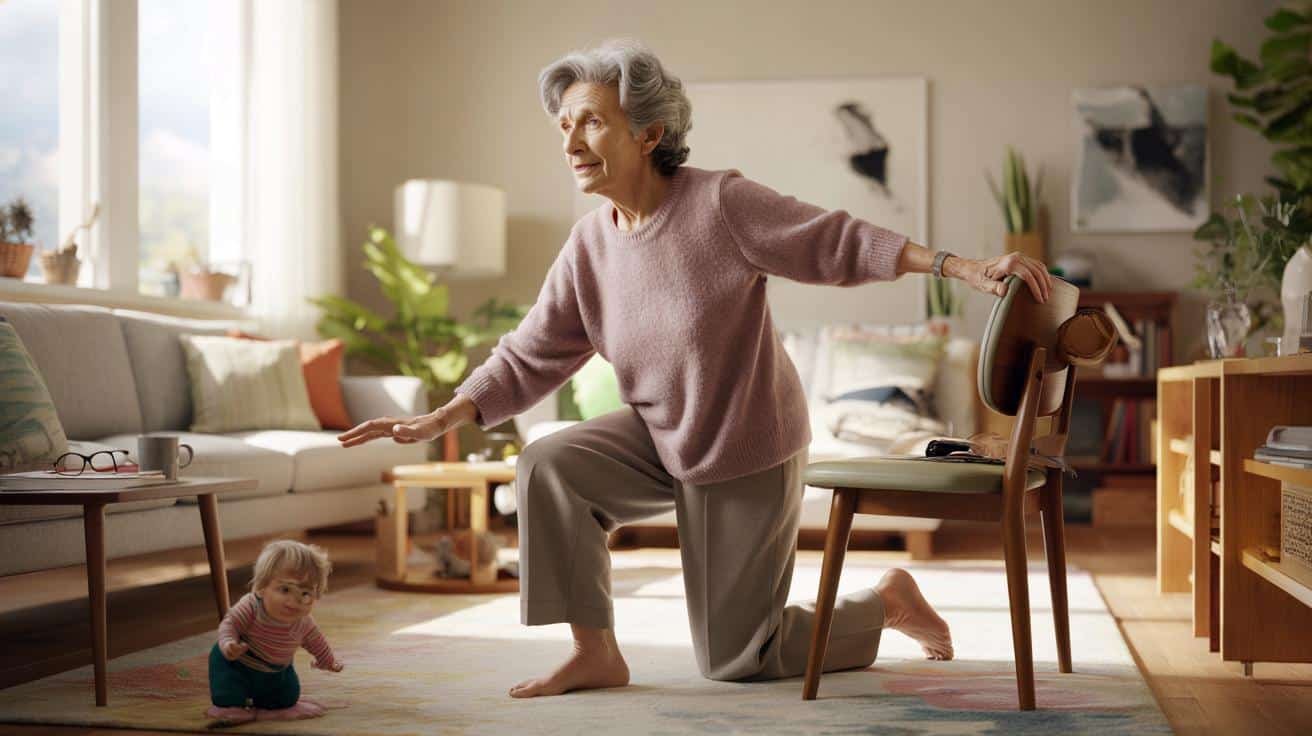
For decades, the advice for staying healthy after 70 has sounded familiar: walk more, go to the gym, stay active. While these habits are undeniably valuable, emerging research and real-world experience suggest they may be missing something critical. Many older adults who walk daily or attend fitness classes still struggle with falls, stiffness, loss of independence, and declining confidence in their bodies.
The missing piece isn’t more exercise. It’s a movement pattern—one that humans evolved to perform daily, but modern life has nearly erased. This pattern doesn’t require machines, memberships, or even long workouts. Yet it may do more to upgrade healthspan after 70 than walking miles or lifting weights alone.
That pattern is the ability to get up and down from the floor smoothly, safely, and often.
Why Healthspan Matters More Than Lifespan
Living longer means little if those extra years are marked by pain, immobility, or dependence. Healthspan—the number of years lived with strength, balance, autonomy, and mental clarity—is what truly defines successful aging.
After 70, the greatest threats to healthspan are not heart attacks or chronic disease alone, but:
- Falls and fall-related injuries
- Loss of balance and coordination
- Muscle weakness and joint stiffness
- Fear of movement leading to inactivity
These issues don’t usually stem from lack of walking or cardio. They arise from the gradual loss of functional movement capacity.
The Overlooked Skill We Lose With Age
Ask a healthy child to sit on the floor and stand back up. They do it effortlessly—without thinking, bracing, or planning. Ask many adults over 70 to do the same, and the task can feel daunting or impossible.
This isn’t because aging automatically destroys the body. It’s because modern life removes the need to practice certain movements:

- Chairs replace the floor
- Cars replace walking and squatting
- Furniture replaces balance and transitions
Over time, muscles weaken, joints lose range, and the nervous system forgets how to coordinate complex movements. The result is not just stiffness—but vulnerability.
Why Getting Up From the Floor Matters So Much
The ability to transition from the ground to standing—and back again—is one of the strongest indicators of long-term health and independence.
Research has shown that difficulty rising from the floor without assistance is associated with:
- Higher fall risk
- Greater likelihood of injury
- Reduced muscle power
- Shorter healthspan
This movement integrates strength, balance, mobility, coordination, and confidence—all in one task.
Walking improves endurance. Gym exercises improve isolated strength. But floor-to-stand movement trains the body as a complete system.
A Full-Body “Upgrade” in One Pattern
Getting up and down from the floor isn’t a single motion. It’s a sequence of coordinated actions involving nearly every system in the body.
Muscles
- Legs generate power
- Core stabilizes the spine
- Arms assist and balance when needed
Joints
- Ankles, knees, hips, and shoulders move through large ranges
- Joint lubrication improves through motion
Nervous System
- Balance reactions sharpen
- Proprioception (body awareness) improves
- Reaction time increases
This integrated demand is exactly what protects against falls and functional decline.
Why Walking Alone Isn’t Enough After 70
Walking is excellent for cardiovascular health, mood, and general mobility. But it is repetitive and linear. It doesn’t challenge:

- Lateral movement
- Rotational control
- Deep joint range
- Rising from low positions
Most falls don’t occur while walking straight on flat ground. They happen during transitions—standing up, sitting down, turning, reaching, or recovering from a stumble.
Floor-based movement trains precisely those scenarios.
The Gym Has Limits, Too
Traditional gym workouts often isolate muscles while minimizing balance demands. Machines stabilize the body for you. Even free weights usually occur in controlled, predictable positions.
What the gym rarely trains is real-world adaptability:
- Uneven surfaces
- Multi-directional movement
- Unexpected shifts in balance
Floor transitions recreate real-life challenges in a controlled, progressive way.
How Floor Movement Extends Independence
After 70, independence depends on the ability to:
- Get out of bed
- Rise from chairs and toilets
- Recover from a stumble
- Get up after a fall
Practicing floor-to-stand movement maintains the physical and psychological readiness to handle these tasks. Just as important, it reduces fear.
When people know they can get up, they move with more confidence. Confidence leads to activity. Activity sustains healthspan.

Safety First: This Is Not About Forcing the Body
This movement pattern is not about dropping to the floor and struggling back up. It is about gradual, supported practice.
Safe progressions include:
- Using a chair, couch, or wall for support
- Starting from kneeling rather than sitting
- Moving slowly and deliberately
- Pausing at each position
The goal is comfort, not speed or perfection.
If medical conditions exist—such as joint replacements, severe arthritis, or balance disorders—professional guidance is recommended. Adaptation, not avoidance, is the key.
How Often Is Enough?
Unlike traditional workouts, this pattern doesn’t require long sessions.
Even:
- 5–10 minutes a day
- A few controlled repetitions
- Integrated into daily routines
can produce meaningful improvements over time.
Consistency matters more than intensity.

The Mental and Emotional Benefits
Floor-based movement also delivers powerful psychological effects.
It:
- Reinforces self-trust
- Reduces fear of falling
- Improves spatial awareness
- Encourages playful, exploratory movement
Many older adults report feeling “younger” not because pain disappears, but because confidence returns.
Cultures That Never Lost This Pattern
In cultures where sitting on the floor remains common, older adults often retain mobility and balance well into advanced age. Their secret is not superior genetics or extreme exercise—it’s daily practice of natural movement.
The body keeps what it uses.
Walking and the Gym Still Matter—But They’re Not the Whole Picture
This is not an argument against walking or strength training. Both are valuable.
But after 70, movement quality and versatility matter more than volume. The body needs reminders of how to move through space, transition between levels, and recover balance.
Floor-to-stand movement provides that reminder in the most direct way possible.

A Simple Reframe for Aging Well
Instead of asking:
“How many steps did I take today?”
or
“How heavy did I lift?”
Try asking:
“Can I get down to the floor and back up comfortably?”
That single question captures strength, balance, mobility, and confidence in one honest measure.
Conclusion: The Skill That Protects the Years Ahead
After 70, the movement pattern that upgrades healthspan isn’t hidden in a gym or measured by a fitness tracker. It’s the simple, powerful ability to move between the ground and standing with control.
By practicing this pattern regularly and safely, older adults preserve not just muscles and joints, but autonomy, resilience, and peace of mind.