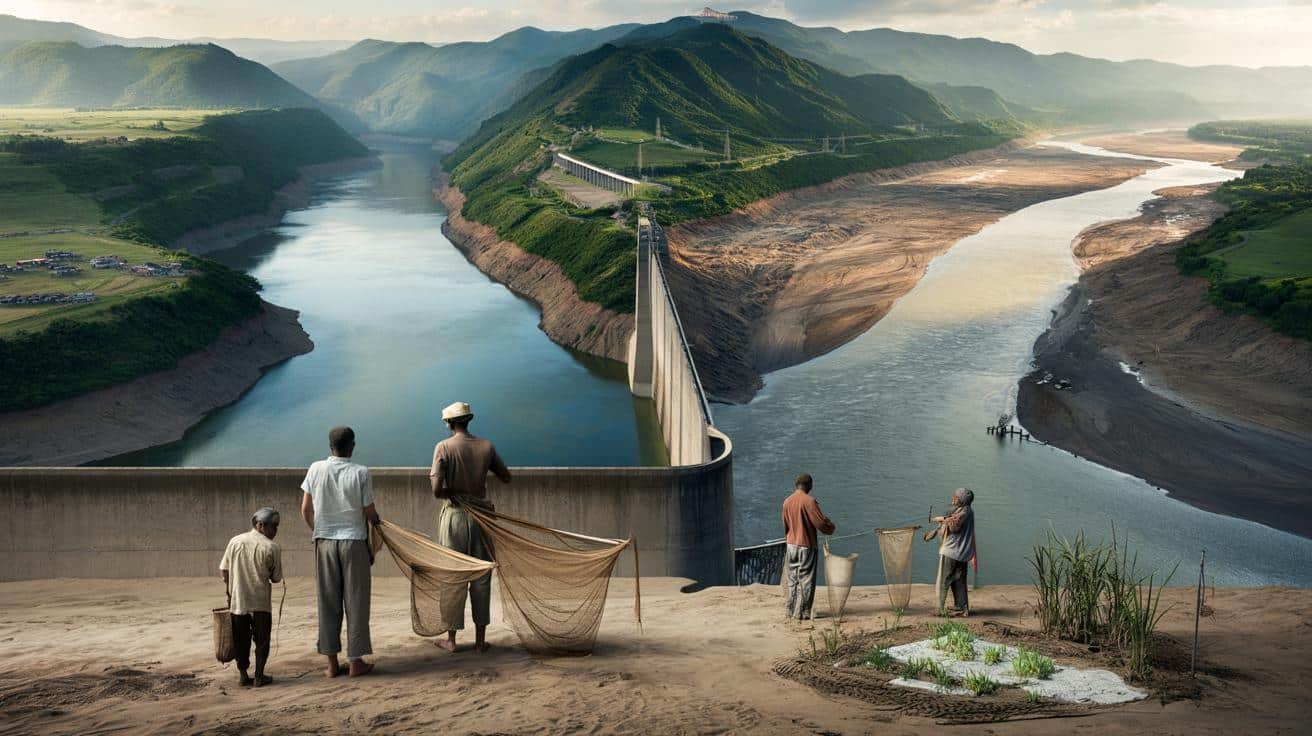
The river looks wide and generous, but the villagers on the bank shake their heads. “It’s thinner,” one of them tells me, dragging his bare feet through the sand that used to be fertile silt. Upstream, hundreds of kilometres away, a wall of concrete holds back the water — and with it, the grains of life that used to flow for free.
Here, fishing nets come up lighter. Vegetable plots are turning salty. A jetty, built only ten years ago, now hangs in mid‑air above a receding waterline. The change is quiet, almost polite, like a neighbour who slowly takes over your garden while smiling at you across the fence.
People still praise the dam for its electricity, its prestige, its promise of “modern development”. Downstream, those same promises feel strangely hollow. Something vital has gone missing, and you can’t see it with the naked eye.
The invisible cargo rivers used to carry
Stand on almost any big river delta at sunset and look at the light. It reflects off the water, sure, but it also glows in the soil, in the muddy banks, in the rough hands of farmers who once trusted the flood. For thousands of years, rivers didn’t just bring water. They brought sediment — a constant, quiet convoy of sand, silt and clay, rolling down from mountains to sea.

This *invisible cargo* is what built Egypt’s fertile Nile Valley, fed rice paddies on the Mekong, and shaped the wide, stubborn Mississippi Delta. Every season, floods would spill over the banks, drop a thin layer of fine material, and retreat. Farmers read these patterns like a calendar. No app, no satellite, just the rhythm of mud and water. Interrupt that cycle, and everything downriver starts to wobble.
On the Nile, the construction of the Aswan High Dam in the 1960s changed that ancient conversation overnight. Before the dam, annual floods spread a silky layer of nutrient‑rich sediment over fields, a natural fertilizer that sustained millions. Once the concrete rose, nearly all that sediment started settling at the bottom of the reservoir instead. Downstream, farmers suddenly had to buy chemical fertilizers to replace what the river no longer delivered. Coastal fisheries shrank as less silt reached the Mediterranean, and parts of the Nile Delta began to erode, eaten away by waves that no longer met fresh material from upstream.
The Mekong tells a similar story, only faster. A boom in dams along its main stem and tributaries has trapped huge amounts of sediment that used to nourish Cambodia’s floodplains and Vietnam’s delta. Researchers estimate that the Mekong’s sediment supply to the sea could drop by more than half this century. In the Vietnamese Mekong Delta, one of the world’s great rice bowls, farmers are watching their fields sink and their canals deepen as the soft ground compacts without new deposits. Up to 20 million people live in that sinking landscape, caught between rising seas and emptying rivers.
Rivers are not just pipes that move water from A to B. They are conveyor belts of matter and energy, constantly reshaping land. Dams interrupt this movement in a very physical way. Behind the wall, the river slows down. When the flow slows, heavier particles of sand and gravel fall to the bottom of the reservoir, building up like a hidden underwater delta. Finer silt and clay may travel a bit farther, but much of it also gets trapped, especially in long, narrow reservoirs. Downstream, the water that emerges from the dam is often clearer, “hungrier” water with more energy than sediment to carry. That clear water then starts to erode riverbeds and banks, stealing material from one place because it can no longer get it from upstream.

Rethinking dams when the problem is sediment, not just water
Engineers and river communities are slowly learning a new habit: to treat sediment as a resource, not a nuisance. One concrete way to do this is to design and operate dams with sediment “pass‑through” in mind. Instead of trapping everything, operators can release controlled high‑flow pulses that mimic natural floods and flush out some of the accumulated material. This might mean lowering reservoir levels at specific times of year, opening bottom gates, or synchronising the releases of several dams in a cascade.
It’s not simple, and it won’t look perfect on a spreadsheet. Power production may dip temporarily, boat traffic might need to pause, and water managers must work closely with downstream communities so sudden releases don’t turn into disasters. Yet targeted sediment management can give deltas a fighting chance. On the Rhône and the Colorado, for example, managed flood releases have helped rebuild sandbars, restore habitats and bring more sediment downstream without scrapping the dams entirely.
Many countries rushed into dam building with a kind of engineering bravado. Walls went up faster than the science evolved. Now, planners are starting to face a more uncomfortable task: admitting that some dams sit in the wrong places, or try to do too many things at once. Soyons honnêtes : personne ne fait vraiment ça tous les jours, regarder un barrage et se demander si sa conception respecte la vie d’un delta à 800 kilomètres de là. Yet this is exactly the kind of question future energy and water plans need to ask, especially for new projects in sediment‑rich basins like the Himalayas or the Andes.
When governments talk about better dam management, the conversation easily gets lost in jargon. So here’s a simple informal checklist for readers who want to understand whether a project respects sediment and downstream lives:

- Does the dam design include low‑level outlets or bypass tunnels for sediment?
- Are flood pulses or sediment flushing events part of the operating rules?
- Have downstream farmers and fishers been consulted about changes in flood timing?
- Is there a plan to monitor erosion, salinity and delta subsidence over decades?
- Are alternatives like solar or wind being weighed fairly for energy production?
The human cost of “clean” energy that chokes a river
On a muggy night in a coastal village, a fisherman spreads out his nets, patching up the holes by lamplight. His son, eight years old, traces his finger across a map printed on an old schoolbook: a blue line running from mountains to sea. That line used to mean a path for fish and silt and floating logs. Now it’s a series of rectangles, each representing a dam. The father lowers his voice. “When I was his age,” he says, “the river brought us the soil and the fish. Now it brings us stories about electricity we cannot afford.”
We’ve all had that moment where a “green” solution starts to look less shiny up close. Large hydropower dams often wear the badge of clean energy. No smokestacks, no coal dust, a neat number on a climate pledge. Yet the hidden costs pile up where the water slows and the sediment stops. As deltas compact and erode, saltwater pushes inland, poisoning wells and rice paddies. Coastal mangroves lose the muddy foundation they need to grow. Storm surges bite deeper, sometimes turning what used to be minor floods into full‑scale disasters for villages with nowhere left to move.
For millions downstream, this isn’t an abstract “environmental impact”. It’s the loss of a safety net. Poor families depend on fertile floodplain soils they don’t have to pay for, on wild fish that migrate with seasonal flows, on sandbars that act as natural levees. When sediment cycles are broken, these quiet subsidies vanish. People then spend more on fertilizer, on pumped irrigation, on repairing storm damage. Some leave altogether, joining the growing ranks of climate‑pressured migrants. **The river that once fed them becomes another risk factor they must escape.**
Scientists warn that in some of the world’s great deltas — Ganges‑Brahmaputra, Mekong, Nile, Mississippi — the combined effect of trapped sediment, groundwater pumping and sea‑level rise could push vast low‑lying areas below the high‑tide line within decades. That doesn’t automatically mean they’ll disappear under water, but it does mean more frequent flooding, more salt, more strain. *A dam built hundreds of kilometres away, celebrated at a ribbon‑cutting ceremony, quietly helps shape whether a child in a coastal village will be able to grow rice on the same plot as their parents, or whether that land will dissolve into a brackish memory.* This is the slow drama playing out right now, often ignored in the glow of megawatt statistics.

The next time you see a glossy photo of a vast new reservoir, mirror‑smooth and framed by mountains, try to picture what’s missing from the image. The grain by grain downstream cost. The boat grounded where a navigation channel used to be deep. The farmer standing in a field that needs more fertilizer every year. The coastal family building their house a little higher than the last one, because the ground feels less certain than it did for their grandparents. These are not anti‑development stories. They are the other half of the ledger that rarely makes it into the launch speeches and project reports.
Some countries are starting to experiment with new rules: no more dams in the last free‑flowing segments of major rivers, mandatory sediment‑passage features, or even the removal of aging, inefficient dams. Others double down, racing to dam every possible tributary in the name of national pride or energy security. The outcome isn’t predetermined. It will depend on whether we treat rivers as living systems with a memory and a downstream future, or as simple infrastructure channels to be switched on and off from a control room.
Talking honestly about sediment isn’t glamorous. It’s mud, not marble. Yet mud is what keeps millions of people fed, housed and rooted where they are. **The strange truth is that some of the smartest climate investments we can make are not about adding new things, but about letting ancient processes keep doing their quiet work.** Letting a river carry its load. Letting a delta breathe. Letting communities downstream have a real say in how many times their lifeline gets pinched by concrete. The map in that child’s schoolbook doesn’t have to be a chain of broken links. It can still be a flowing story.
| Point clé | Détail | Intérêt pour le lecteur |
|---|---|---|
| Rivers move sediment, not just water | Sand, silt and clay carried downstream build fertile soils and deltas | Helps you see why dams reshape far‑away farms, coasts and cities |
| Dams trap this “invisible cargo” | Reservoirs act as sediment sinks, starving downstream areas and fueling erosion | Explains how a single dam can affect your food, flood risk and local economy |
| Sediment‑smart planning is possible | Design choices, flushing flows and honest trade‑offs can reduce the damage | Gives you concrete questions to ask about new “clean energy” projects |
