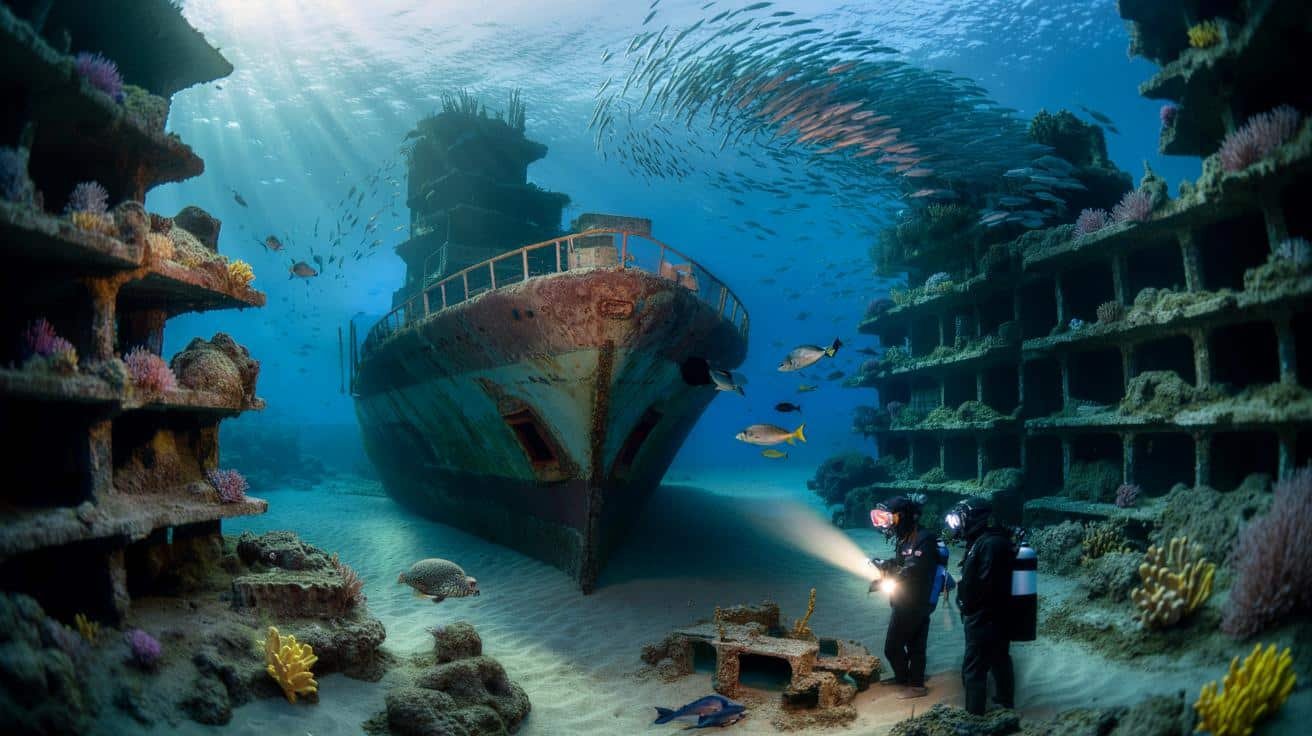
On the sonar screen in the tiny cabin, shapes appear where the chart insists there’s only sand. Outside, the sea looks empty, flat, indifferent. But 20 meters below, an entire city is waking up.
A dive team rolls backward into the water, bubbles fizzing to the surface. Their beams of light slice through the blue and hit something that should not be here: the rusted bow of a 90‑meter ship, resting calmly on the seafloor. Around it, concrete blocks rise like half-finished apartment towers, already crusted in pink and orange life.
Fish swirl in tight silver clouds. Corals are creeping over metal scars. Turtles move slowly between the structures like wary new tenants. None of this existed a decade ago.
Everything here is artificial.
The life is not.
How a country turned shipwrecks into underwater cities
On an old naval dock, just before dawn, a retired warship waits for its final mission. Welders adjust the last openings, engineers triple-check the ballast, and a small crowd of locals leans against the railings, coffee in hand. The air smells of diesel and sea salt.
This ship once patrolled borders. Today it’s being prepared as the foundation of a future reef. Holes have been cut in the hull to let water and fish pass, fuel tanks scrubbed clean, dangerous materials ripped out. The steel giant looks wounded, almost skeletal, yet strangely dignified. In a few hours, it will disappear beneath the waves and start a second life nobody on board ever imagined when it was launched.

This is not a one-off publicity stunt. It’s now a national strategy. Over the past few years, this country has quietly sunk dozens of decommissioned ships and dropped thousands of purpose-built concrete modules along its coast. The goal is both radical and oddly simple: rebuild damaged marine ecosystems from scratch, using human-made structures as scaffolding for wild life to return.
One of the earliest sites sits off a sleepy fishing town that had watched its catches shrink every year. Locals still tell the story of the first time divers went down to the newly sunk freighter. At first there was only silence, sand and the eerie bulk of the ship resting like a ghost on the bottom.
Three months later, divers returned to find the hull dusted with algae and sponges, like the first graffiti on a clean wall. Tiny damselfish darted around the portholes. A lone grouper had already claimed the shadow of the bow. After a year, lobster traps nearby began coming up heavier. Not full, not like the old days, but no longer heartbreakingly empty either.
Today that same wreck is a magnet. Snorkeling tour operators time their departures with the tide, and the harbor car park fills with vans loaded with tanks and fins. A recent survey counted more than 120 species around the artificial reef, including some that had vanished locally years before. The fishermen still grumble, as fishermen do, yet many admit the offshore structures have become nurseries feeding life back toward the coast.
The logic behind these underwater experiments is almost disarmingly straightforward. Marine ecosystems need three basic things: hard surfaces to colonize, shelter from predators and currents, and enough time undisturbed to let food webs rebuild. Sandy bottoms, which cover huge stretches of coastal sea, don’t offer much of that on their own.

Ships and concrete blocks change the rules. They act like cliffs where there were only plains. Their cavities and overhangs create micro-habitats, from dark crevices for crustaceans to smooth faces where corals, oysters and algae can anchor. Once the first layer of life settles, everything else follows: plankton feeders, then small fish, then hunters. Within a few years, what started as rust and grey cement begins to look and behave like a natural reef, even if its skeleton was drawn on an engineer’s computer.
There’s risk, of course. Dump the wrong structures in the wrong place and you just shift the problem or add new pollution. That’s why this nation moved from chaotic, local “reef projects” to a coordinated program with marine biologists, coastal engineers and fishing communities at the same table. Artificial reefs are not magic. They’re tools. And like any tool, they can harm or heal depending on how they’re used.
The quiet craft of building a living reef from scrap
Behind each dramatic ship-sinking video lies months of tedious, meticulous work. The first rule the team repeats, almost like a mantra: the structure must be clean. That means empty fuel tanks, no loose cables, no flaking toxic paint. Every compartment where air could get trapped is opened so the vessel settles safely and doesn’t become an underwater time bomb.
The second rule is shape. Marine architects now design some artificial reef modules from scratch, using 3D models to predict how currents will move around them. They carve tunnels for fish, design flat platforms for coral fragments and round openings where light can pierce the gloom. It’s almost like building a neighborhood without any guarantee of who will move in. Still, years of trial and error have shown that varied, complex shapes host richer life than simple cubes or flat slabs.
Teams have learned these lessons the hard way. In the early days, well-meaning local projects dumped everything from scrap cars to old tires into the sea, hoping life would somehow appear. On a map, those areas were marked as “reefs”. Underwater, divers later found sad, collapsing junkyards tangling nets and shedding chemicals. Soyons honnêtes : personne ne fait vraiment ça tous les jours, mais certains choix faits en une matinée peuvent hanter un écosystème pendant des décennies.

Now the national program uses strictly controlled materials: treated steel, marine-grade concrete, sometimes even engineered ceramics made to mimic natural rock. The work has shifted from dumping to designing.
There’s a human side to this learning curve too. On a windy afternoon, a marine biologist I met leaned against the railing of a research boat, watching a barge position a cluster of new concrete modules. Her voice was half proud, half cautious.
That nuance shapes the program’s daily decisions. Instead of placing artificial reefs everywhere, teams map migration routes, spawning grounds and fishing patterns, then leave buffer zones where the sea can continue its own rhythms. They talk with fishers before drawing lines on maps, trying to avoid turning cooperation into conflict.
- Pick sites where natural reefs once thrived, not random empty seabeds.
- Use clean, durable materials that won’t leach toxins or collapse quickly.
- Combine artificial reefs with fishing limits, not as a shortcut around them.
- Monitor for years, not months, to see real ecological change.
- Involve local communities early, so “their sea” doesn’t feel stolen.
On a more emotional level, this work forces a sort of double vision. You have to look at a dead coastline and imagine color coming back slowly. You also have to accept that some losses won’t reverse in a human lifetime. Scientists here speak quietly about “triage” — choosing where to focus resources and where to simply protect what’s left. It’s not a heroic story. It’s an honest one.
What these underwater experiments say about us
Visiting one of these artificial reefs as a diver changes the way the news sounds. You read stories about coral bleaching, collapsing fish stocks, warming seas, and it all feels impossibly big. Then you remember the moment you hovered next to a porthole and watched a whole community of fish defend their tiny patch of hull like it was the center of the universe.

On a night dive, the same wreck looks completely different. Octopus arms explore the edges of concrete arches. Shrimp eyes reflect your torch like tiny red LEDs. The artificial lines of the ship blur under thick layers of life, as if nature is slowly erasing the human origin story and replacing it with its own. It’s unsettling and strangely comforting at the same time. We built this, yes. But we are clearly not in charge down here.
There’s a quiet lesson in that reversal. For decades, humans have mostly reshaped the ocean through extraction: taking fish, dredging sand, drilling oil. Here, for once, the reshaping is about adding structure and then stepping back. It feels almost modest. *We’ll give you walls, says the program to the sea. The rest is up to you.*
That doesn’t make it a silver bullet. Artificial reefs can attract fish away from natural reefs, giving a false impression of abundance. They can become hotspots for overfishing if rules aren’t respected. They can fail, becoming lifeless sculptures in a warming, acidifying sea. On a bad day, the whole idea can feel like rearranging furniture on a slowly flooding house.
On a good day, though, these reefs look like something else entirely: rehearsal. Proof that, given a bit of help and less pressure, marine life is still wildly capable of bouncing back. The question hanging in the air after every dive, every meeting, every new ship sent to the bottom is simple and heavy.
What would happen if we scaled this mindset, not just the structures?
We’ve all had that moment where a landscape from childhood suddenly looks smaller, thinner, emptier than we remember. For many coastal communities, the sea has gone through that same shrinking. Stories from grandparents about dense shoals and noisy reefs sound almost mythical now. Seeing a dead patch of sand turn into a living, moving maze over a few years doesn’t erase that grief, yet it does something gentler: it makes “too late” feel less absolute.

Maybe that’s the quiet power of these artificial reefs. They don’t pretend that damage never happened. They don’t restore some frozen “before” picture. Instead, they offer a rough, steel-and-concrete bridge between what we broke and what could still grow. Imperfect. Industrial. Real.
And once you’ve watched an entire new ecosystem weave itself around the skeleton of a discarded ship, it gets harder to believe that our only role in the ocean story is as the villain. There’s a different script available — not heroic, not clean, but possible. One ship, one block, one new reef at a time.
| Point clé | Détail | Intérêt pour le lecteur |
|---|---|---|
| Des épaves comme fondations | Des navires nettoyés et préparés sont volontairement coulés pour servir de support à la vie marine | Comprendre comment un déchet industriel peut devenir le cœur d’un écosystème florissant |
| Des récifs conçus sur mesure | Des blocs de béton et modules complexes sont dessinés pour offrir abris, courants et lumière adaptés | Visualiser le “design” invisible qui façonne les futurs paysages sous-marins |
| Rebond de la biodiversité locale | Retour de dizaines d’espèces, amélioration des prises et nouveau tourisme de plongée | Voir les bénéfices concrets sur l’économie côtière et la vie quotidienne des habitants |