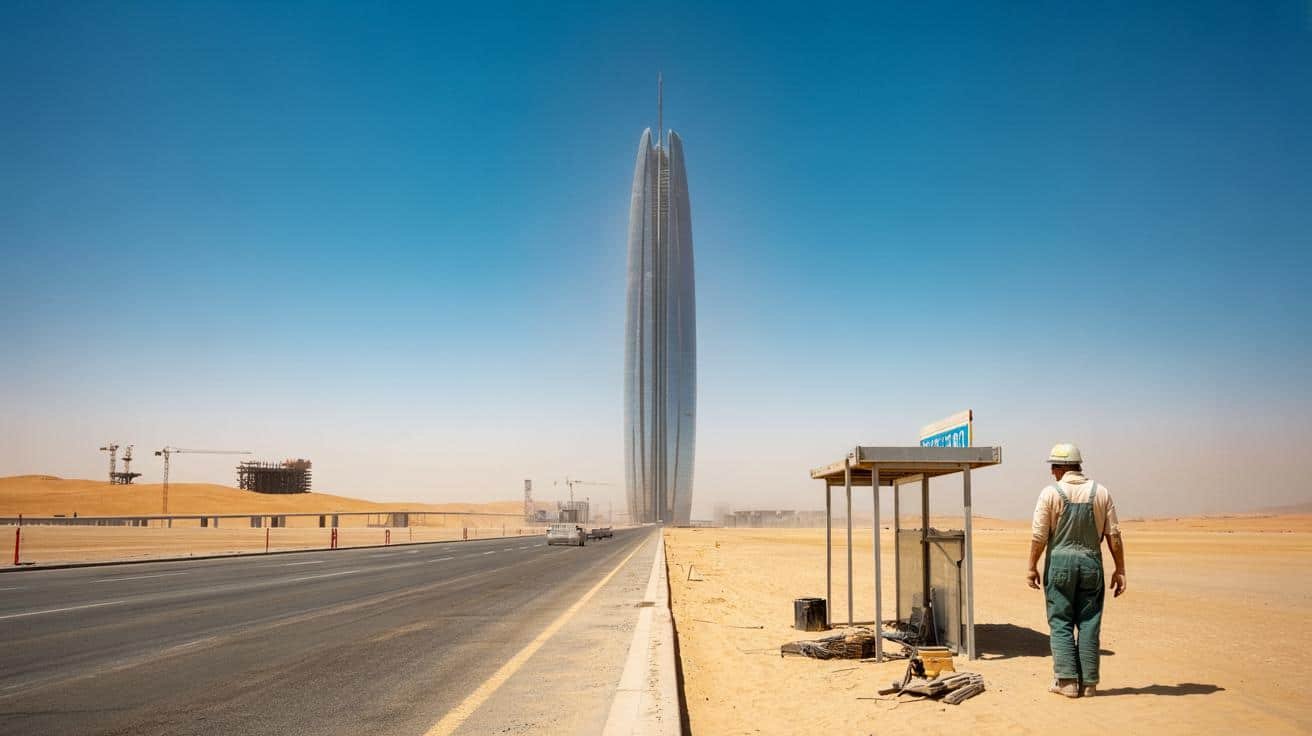
The render in my inbox looked like science fiction. A needle of glass and steel, one kilometer high, rising from a flat beige nothingness. No streets. No shade. Just a lonely monument surrounded by sunburnt sand and marketing slogans about “the future of living.”
I imagined standing at its base at noon, the heat pushing up from the ground, the air trembling, the thin strip of shadow crawling across an empty parking lot. A 1 km tower in the desert suddenly felt less like progress and more like a luxury space shuttle launch pad that forgot to leave Earth.
Some projects don’t look like the future once you picture actual people inside them.
The fantasy of height vs. the reality of heat
Urban planners love to talk about density. They show charts proving that building up is more efficient than building out, especially in growing cities. On paper, a 1 km tower sounds like the ultimate expression of that logic, a vertical city that sips land and concentrates life.

Yet context changes everything. Drop that same tower in a dense, walkable city and it tells one story. Drop it in an empty desert and it tells another. Then it just looks like a trophy for people who won the budget war. Or a power move carved into the skyline.
Look at what already exists. The Burj Khalifa in Dubai rises 828 meters, the tallest structure humanity has actually managed to keep standing and air-conditioned. It’s an engineering marvel, yes, but also surrounded by an urban fabric: malls, highways, waterfronts, workers’ housing. The desert is still there, yet it’s framed by streets and systems that at least pretend to serve a city.
Now stretch that logic another 200 meters in a place where there may be no city at all, only a promotional video of flying taxis and drone deliveries. You end up with a building designed more for helicopter shots than for bus stops. For rankings on “world’s tallest” lists, not for the guy cleaning the 450th-floor windows in 48°C heat.
That’s the quietly absurd part. The desert doesn’t care about your render. It cares about physics. A 1 km tower needs vast energy to pump water, cool air, move people up and down all day. An enormous concrete and steel spine radiating heat into an already roasted environment. We call it sustainable because it has solar panels on the brochure. Yet most of the sustainability math happens offstage, in power plants, desalination stations, and supply chains crossing oceans.

*You can’t Photoshop away thermodynamics.*
Progress that forgets people isn’t progress at all
There’s a simple practice many architects quietly use when a project feels too abstract. They pick a random person and walk through a day in their life inside the building. Not a billionaire owner, not a visiting CEO. A nurse, a cleaner, a young couple with a baby. They imagine the commute, the air, the noise, where coffee comes from at 6 a.m.
Do this with a 1 km desert tower and the illusions start peeling off fast. You notice how much of your fantasy depends on invisible servants: maintenance teams, delivery drivers, construction workers who won’t be living in the glossy part of the tower. You also notice how much of the promise relies on endless electricity humming in the background, as if blackouts and water shortages were stories from a different planet.
If you’ve ever lived in a hot climate, you know the small rituals that keep you sane. Shady sidewalks, trees that actually touch each other, corner groceries, bus stops that aren’t metal ovens. Our brains quietly calibrate comfort using these cues. When they’re missing, stress rises, even if the air conditioning is “perfect.”
That’s what makes vertical desert utopias feel strange. They skip the simple stuff and jump straight to spectacle. You don’t see how kids would safely walk to school, where teenagers would hang out without spending money, how older people would step outside when lifts fail. You only see sky lounges and infinity pools. Let’s be honest: nobody really does this every single day. Most people just need a reliable elevator and a decent place to buy bread.

There’s also a deeper social crack. Buildings this extreme don’t tend to mix people; they stratify them. The higher the floor, the higher the status. The more isolated the desert locale, the more everything turns into a controlled bubble: access passes, once-in-a-lifetime visits, choreographed events. That’s the opposite of a city, which thrives on random encounters and friction and shared problems.
Promoted Content
When progress means sealing a narrow elite inside a climate-controlled spear in the sand, what you’re really designing is not a future. It’s a bunker. A very photogenic one, but still.
How to spot fake “progress” before it eats the skyline
There’s a little test you can run on any mega-project, whether it’s a desert tower, a smart city, or a gigantic stadium. It’s not scientific, but it works frighteningly often. Ask: “Who would be here at 3 p.m. on a Tuesday, and what are they doing?” If the only believable answer is “tourists taking photos” or “VIPs at a conference,” you’re probably not looking at real urban life.
Then try another angle: “What happens here when something goes wrong?” A power cut, a water supply glitch, a sandstorm that grounds flights. Are people stranded in glass capsules 600 meters up, or can they step into a neighborhood, buy a bottle of water, find shade under a tree? Real progress usually includes a boring backup plan.

We’ve all been there, that moment when a shiny new project opens and everyone crowds in for selfies. The mall, the museum, the pedestrian bridge that suddenly becomes an Instagram darling. For a few weeks, it feels like a city has leveled up. Then the cracks appear: impossible traffic, broken escalators, lifeless plazas nobody uses once the novelty fades.
It’s easy to feel small facing all this, like big decisions live in boardrooms we’ll never enter. Yet you still have more power than you think. The way you talk about these projects with friends, the way you vote, what you share or question online, all of that feeds the quiet feedback loop that politicians and developers absolutely track, even when they pretend they don’t. Skepticism is not being against progress. It’s being against expensive illusions.
“Architecture is not about the building,” an urban designer in Dubai told me once, looking up at a cluster of towers. “It’s about what happens between the buildings. That’s where life is.”
- Look for the ground
If every render starts from the sky, zoom out mentally. Where are the sidewalks, bus stops, bike lanes, trees? - Follow the workers
Who builds it, who cleans it, who keeps it running? If their lives are invisible in the plan, something’s off. - Check the water and power story
Desert mega-projects depend on insane amounts of both. Ask where they really come from and what happens when they falter. - Notice the neighbors
Is there an actual city around this thing, or is it a solitary object in the void? - Ask what problem it solves
If the answer is mostly “put us on the map,” that’s not progress. That’s branding.
When ambition becomes a mirror, not a blueprint
There’s nothing inherently wrong with dreaming tall. Humanity has always pushed upwards, from cathedrals to radio towers to skyscrapers that scrape low clouds. The question isn’t whether a 1 km tower in the desert is technically possible. The question is why we keep calling this kind of thing “progress” with a straight face.
Take away the drone footage and look again. Sometimes these megaprojects are just anxiety written in concrete: fear of a post-oil world, of political irrelevance, of being forgotten. Height becomes a way to shout into history. The desert becomes a blank canvas for people who don’t want to deal with the messy compromises of real cities and real citizens.

If progress meant stacking people higher and higher on air-conditioned pedestals, we’d already be living in paradise. We know we’re not. Cities that quietly invest in shade, transit, public schools, local food, flood protection, boring maintenance — they rarely go viral. Yet they are the places where life feels strangely bearable when the world outside heats up, literally and metaphorically.
Maybe that’s the strangest thing about a 1 km tower in the desert. It’s sold as a vision of tomorrow, but it already feels dated, like a farewell letter to common sense we didn’t agree to sign. The real future might be shorter, shadier, slower, stitched together at street level by people who will never set foot in a sky bar, and who don’t need a monument to know they exist.
| Key point | Detail | Value for the reader |
|---|---|---|
| Context beats spectacle | A mega-tower in an empty desert works more as a trophy than as a city | Helps you mentally sort genuine urban progress from pure branding |
| Follow everyday lives | Imagine a nurse, cleaner, or family living and moving through the project | Gives you a concrete way to question unrealistic futuristic promises |
| Ask the basic questions | Who is it for, how is it powered, what happens when things fail? | Equips you to challenge “inevitable” megaprojects with grounded common sense |